


-32x32.png)


-32x32.jpg)


-250x250h.jpg "Neutral | O60001 | Men's Heavy Organic T-Shirt")
-250x250h.jpg "Neutral | O60001 | Men's Heavy Organic T-Shirt")


-32x32.jpg)


-250x250h.jpg "Russell | 108M | Men's T-Shirt Pure Organic")
-250x250h.jpg "Russell | 108M | Men's T-Shirt Pure Organic")
-250x250h.jpg "Neutral | O61001 | Men's Organic T-Shirt")
-250x250h.jpg "Neutral | O61001 | Men's Organic T-Shirt")


-32x32.jpg)




-220x220.png "Lanyards")


-24x24.jpg)


-24x24.jpg)


-24x24.jpg)


For orders where the same design needs to stay clean, consistent and repeatable across multiple items.
Screen printing works best for mid-size and larger runs of T-shirts, hoodies, bags and workwear. It is suitable for logos, lettering and graphics with clear colour areas.
Recommended for screen printing


-400x400h.jpg "B&C | #E190 | Heavy T-Shirt")


Screen printing is a practical choice when you need a durable, consistent and repeatable print across a larger number of garments.
For business textile orders, the decision usually comes down to appearance, price and intended use. Screen printing works well when the same design is repeated on T-shirts, hoodies, bags, aprons or workwear. It is most commonly used for logos, lettering, typography and artwork with clean colour areas where the result needs to look consistent across the full order.
Many projects are now compared with DTF transfers, especially because DTF is practical for smaller quantities, full-colour artwork and mixed garment orders. This is understandable, as price is an important factor for most buyers in 2026. Still, traditional screen printing remains a strong option when repeatability, clean colour areas, durability and a coordinated business appearance matter.
When is screen printing the right choice?
Screen printing is most suitable for mid-size and larger runs, where the setup cost is spread across more items. As a practical starting point, it is worth considering from around 50 pieces, especially when the same design and a similar print position are used.
- when a larger number of T-shirts, hoodies, bags or workwear items need the same print,
- when the design has clearly separated colours,
- when the full order needs a consistent visual result,
- when the artwork is based on a logo, slogan, lettering or clean graphic elements,
- when the same design may be repeated in later orders.
Why screen printing still works well for promotional textiles
The main strength of screen printing is dependable repetition. Colours can appear clean, solid and clear, the edges of the design can remain sharp, and the final result is suitable for companies, teams, events, trade fairs, hospitality, sales campaigns and work environments.
With suitable artwork and correct preparation, the print can be produced with a controlled ink deposit, so the feel on the garment does not have to be overly heavy. For larger runs, screen printing can also be cost-effective, because the setup is divided across more items. This is why it is still commonly used for branded textiles that need to look coordinated, professional and durable enough for regular use.
Screen printing on T-shirts, hoodies, bags and workwear
Screen printing is most often used for promotional T-shirts, team shirts, hoodies, textile bags, aprons, workwear and other items where the material is technically suitable. The design itself is only one part of the decision. Garment colour, fabric composition, print size, intended use and washing frequency also matter.
A T-shirt for a one-day event, a work shirt for field use, a hoodie for a team and a textile bag for a campaign do not have the same requirements. Before production, it is useful to align the garment, print position and decoration method. Gajcom can also help select suitable promotional textiles, not only produce the print.
When should another technique be used?
Screen printing is not always the most rational choice. For small quantities, photographs, soft gradients, very fine details or designs with many colours, DTG printing or DTF may be more suitable. DTG is particularly useful on cotton T-shirts where a soft digital feel and detailed artwork are important. DTF is practical for mixed materials, smaller runs and full-colour designs.
For polo shirts, caps, jackets and workwear where a more formal or especially durable logo appearance is required, embroidery may also be worth considering. The right method depends on quantity, artwork, material, budget and the expected final appearance.
How does the ordering process work?
- You send the logo or artwork, approximate quantity, selected garments and basic information about how the items will be used.
- The design, number of colours, material and quantity are checked to see whether screen printing is the right method.
- Print size, position, colours and garment choice are aligned before production.
- After approval, the order is prepared for production and the estimated production time is confirmed.
- Once completed, collection or delivery is arranged.
You do not need a complete brief to start. A logo or rough idea, an approximate quantity and a short note about how the textiles will be used are enough for an initial assessment. Based on that, it is possible to check whether screen printing, DTF, DTG or embroidery is the more suitable option.
Consistent prints for T-shirts, hoodies, bags and workwear
General Questions
Images of screen printed products
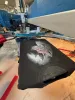 direct print lynx
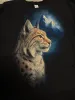 Lynx on a T-shirt
 Lynx photographed up close
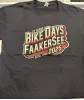 T-shirt for the event /BikeDays
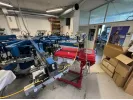 T-shirt printing house
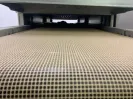 T-shirt in the drying channel