


Food containers make it easier to portion, store and carry meals. When selecting them for employees, teams or corporate gifts, the main considerations are capacity, closure type and intended use: a snack at the office calls for something different from transporting a hot lunch.
This category includes airtight and thermal designs with different stated capacities. Before choosing, consider what the container will hold, whether you need a tighter seal or temperature retention, and what the instructions say about cleaning and food contact.


Need help choosing?
Send us an inquiry about quantity, personalization or choosing a suitable product.
Capacity and shape: what needs to fit?
Stated capacity is a useful starting point, but it does not tell the whole story about usable space. Shape and how food is arranged also matter: sandwiches, salads, side dishes and cooked meals all occupy space differently. Check the outer dimensions if the container needs to fit in a bag or a shared refrigerator. Allow enough room to close the lid properly as well.
Smaller meals and side dishes
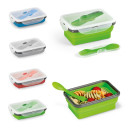
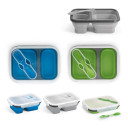
For comparison, see the SAFRON 640 ml airtight container. A two-compartment option is the DILL model with 480 ml and 760 ml compartments. Check the interior and lid design of each model, not just the capacity in millilitres.
Larger portions
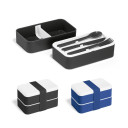
For a more substantial meal, the BOCUSE 1360 ml airtight container may be a useful point of reference. More capacity does not necessarily mean a better shape for every meal. If ordering for a group, decide in advance whether the containers will mainly be used for snacks, lunches or storing individual ingredients.
Closures, temperature and real-world use
An airtight container is designed to close more tightly, but its name alone does not establish that it can safely carry every type of liquid. Thermal containers serve a different purpose: they help limit changes in the contents' temperature. Likewise, a “waterproof” label does not, by itself, prove that a product is suitable for direct food contact.
When temperature retention matters
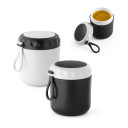
If meals need to be carried warm or cold, compare standard food boxes with the SAMOURA 380 ml thermal container. The term thermal does not specify how long food will remain at the desired temperature; check the instructions for the particular model. The closing mechanism matters for thermal containers too.
Cleaning and branding options
Before selecting a product, check its declared suitability for food contact, permitted temperatures and instructions for hand or dishwasher cleaning. For promotional orders, separately establish whether the selected material and surface are suitable for the desired logo application. Gajcom assesses the branding method according to the product, artwork, quantity and desired outcome; the execution is agreed when preparing the quotation.
Explore more
Frequently asked questions
Is every waterproof container suitable for food?
Not necessarily. Waterproofing describes a property of the closure or protection against water; it does not automatically establish that the material is suitable for food contact. Check the stated purpose and specifications of the individual product.
Can I carry soup in an airtight container without leaks?
Do not rely on the word “airtight” alone. For liquids, check whether the manufacturer specifically states that the container is leakproof, and follow the closing instructions and recommended carrying position.
Can all food containers go in the microwave?
No. Microwave and dishwasher suitability depend on the model, material and any restrictions affecting the lid. Follow the product markings and instructions; do not use it for reheating without explicit confirmation.
What information is useful when ordering containers with a logo?
Choose a model, estimate the quantity, indicate the preferred branding position and provide the artwork. Once the surface and design have been checked, the appropriate method, branding size and quotation can be agreed, without assuming every process works on every container.