


Rulers are simple yet useful tools for measuring distances, drawing straight lines and working with notes. The main selection criteria are length, legibility of the measuring scale and the design of the edge used for drawing or underlining.
For offices, educational institutions and events, they can be practical promotional gifts that remain useful beyond their first use. The current selection also includes wooden rulers; branding with a logo or text can be assessed for a suitable model.
There are no products to list in this category.
Need help choosing?
Send us an inquiry about quantity, personalization or choosing a suitable product.
Choosing a ruler for the task
The same ruler may not be ideal for writing in a notebook, desk work and sketching. Before choosing, consider whether you mainly need to measure short distances, guide a straight line or have a handy tool for everyday use.
Length, measuring scale and edge
A shorter ruler is convenient for a pencil case and small notes, while a longer one helps draw longer lines without repositioning. Check whether the chosen model has clearly marked centimetres and millimetres and whether the scale offers sufficient contrast. A straight, undamaged edge is also important when drawing alongside a ruler.
Material and handling
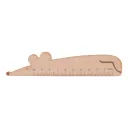
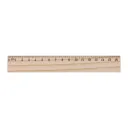
Material affects how a ruler feels in use and how it should be stored. The current selection includes wooden models Looney and OneSix. With wooden rulers, it makes sense to consider exposure to moisture and check how the markings are made on the specific product. Do not infer dimensions or other features from appearance alone.
Rulers in stationery sets and for branding
A ruler pairs naturally with notebooks and notepads or ballpoint pens. When assembling a set, think about whether the items will be used together: for writing and underlining, portability and a legible scale usually matter more than a decorative shape.
Where to position a logo
If you want branded rulers, the chosen surface must be suitable for the marking method. Keep the area around numbers and scale divisions clear so that the design does not reduce the ruler's usefulness. At Gajcom, the personalisation method, artwork size and position are selected according to the material, design, quantity and desired outcome.
What to check before a larger order
For a business or organisational order, compare the intended use, estimated quantity and details of each model. A clear scale may be important for classrooms, while a compact format can be preferable for conference sets. Availability, branding suitability and production details are confirmed for each order, not assumed for every ruler in the category.
Explore more
Frequently asked questions
Is a ruler suitable for precise technical measurement?
A ruler is a common tool for basic measuring and drawing straight lines. However, when a task requires a specified measurement tolerance, accuracy cannot be inferred from the product name alone. Check the specifications of the model and, if needed, choose an instrument designed for that level of measurement.
Is a wooden ruler automatically a more sustainable choice?
Not necessarily. The material alone says little about sourcing, processing or expected service life. If environmental criteria matter to your purchasing decision, rely on verifiable information for the individual model rather than its appearance or the label “wooden”.
What information should I provide for a quotation?
The most helpful details are the chosen model or intended use, estimated quantity, artwork and preferred branding position. These make it easier to assess feasibility and prepare a project-specific quotation without assuming the same options are available for every material.